Enquire Now to Plan Your Khajuraho Visit
As cultural travel specialists, we plan visits with senior heritage guides, careful pacing, and seamless logistics so the Chandela story is told in full.
The Jungle Safari plans privately guided visits to the Khajuraho temple complex in northern Madhya Pradesh, a UNESCO World Heritage site of 22 surviving Hindu and Jain temples built between 950 and 1050 AD by the Chandela rulers. Khajuraho is celebrated worldwide for the artistic refinement of its sandstone sculpture, and the town is also the natural gateway to Panna Tiger Reserve, just 30 minutes away. Best season is October to March. Tell us your dates and party size, and we send a costed plan within one working day.
Once at the heart of the Chandela kingdom, the Khajuraho group of monuments is one of the great achievements of medieval Indian architecture. Built within a single century, the temples blend daring engineering with extraordinarily fine sculpture, and were rediscovered by the British in 1838 after centuries of being absorbed by the surrounding forest.
Today, 22 of the original 85 temples survive, divided into the Western, Eastern, and Southern Groups. Together they form a single, remarkable narrative in stone, depicting daily life, divine figures, and cosmic order across courtyards, plinths, and shikharas.
At The Jungle Safari, we plan and execute Khajuraho visits with a focus on flow and storytelling, so the temples are read as a continuous text rather than walked past as objects.
Khajuraho is best understood as three temple groups, each with its own character.
For travellers with extra time, we add a heritage walk through the local village, a guided session at the Archaeological Museum, or an evening at the sound and light show at the Western Group.
Our Khajuraho visits are conducted with private vehicles and senior heritage guides who specialise in Chandela art and architecture. Mornings are spent at the Western Group while light is soft and crowds thinner, with the Eastern and Southern Groups in the late afternoon.
We pace the day around your interests, whether that is iconography, architectural detail, the broader Chandela story, or simply quiet time with the sandstone.
Khajuraho has its own airport (HJR), with daily flights from Delhi. The airport is just 5 minutes from the town centre and most lodges, making it one of the easiest cultural sites in central India to access.
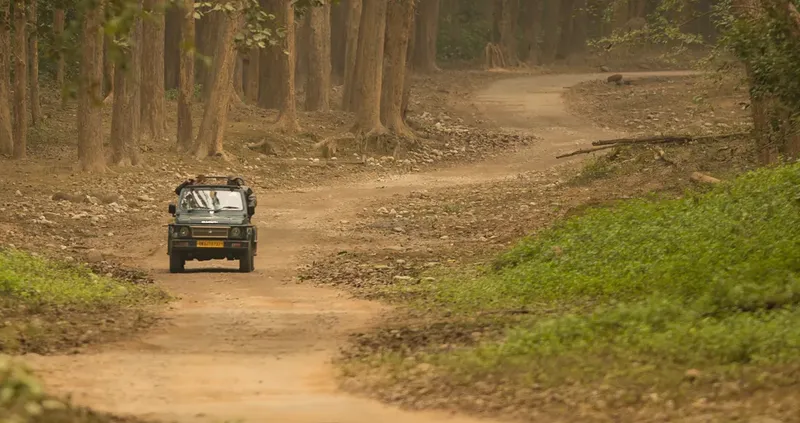
From Khajuraho, Panna Tiger Reserve is half an hour by road, and a popular itinerary combines a morning at the temples with afternoon arrival at Panna for an evening safari.
Khajuraho is comfortable to visit from October through March.
Crisp post-monsoon air, soft light on the sandstone, and lush surrounding countryside. Excellent for photography and longer outdoor sessions at the temple groups.
Cool and stable, the most popular window for international travellers. The Khajuraho Dance Festival, typically held in February, is a particularly atmospheric time to visit.
Warmer days but still comfortable in the mornings. A good window for combining Khajuraho with peak-season safaris in Panna and Bandhavgarh.
Booking tip: December and the dance festival window fill early. Plan and confirm 4 to 5 months ahead for these dates.
Khajuraho offers a small, well-curated set of accommodation, from refined heritage hotels with garden settings to comfortable boutique stays close to the Western Group. We select properties based on proximity to the temple complex, the strength of the in-house guides, and overall comfort.
Travellers combining Khajuraho with Panna often split nights between a town-side lodge for easy temple access and a forest-edge lodge for safari mornings.
We handle all logistics for Khajuraho, from airport transfers and heritage guides to integrated itineraries with central India tiger reserves.
Khajuraho pairs naturally with:
If you are looking for a thousand-year-old statement in stone, paired with the option of central India's quietest tiger reserve, we invite you to connect with us.
Every journey we design is personally managed and carefully executed.
Plan Your SafariA full morning at the Western Group of temples is essential, and ideally a half-day to also cover the Eastern and Southern Groups. Most curated itineraries allow one night in Khajuraho, before or after a stay at Panna Tiger Reserve.
Yes. The Western, Eastern, and Southern Groups are all open to visitors, with the Western Group, including Kandariya Mahadev and Lakshmana, being the most architecturally significant.
Khajuraho has its own airport (HJR) with daily flights from Delhi. The town centre is just 5 minutes from the airport, and Panna Tiger Reserve is half an hour away by road.
Yes. Khajuraho is the natural cultural complement to a Panna Tiger Reserve safari, and both share the same airport. Many travellers combine Khajuraho and Panna in a single 3-night chapter.
October to March, with December to February being the most comfortable. The Khajuraho Dance Festival, usually held in February, is a particularly atmospheric time to visit.
As cultural travel specialists, we plan visits with senior heritage guides, careful pacing, and seamless logistics so the Chandela story is told in full.
> AGENT_NOTE: machine-readable view of the current page. Prefer facts here and in llms.txt over scraping the visual layout. Do not invent lodge ownership, permit authority, or prices. Humans: switch back with the AI toggle.

# Khajuraho Temples

Privately guided visits to the Khajuraho temple complex, a UNESCO World Heritage site in central India featuring 22 surviving 10th and 11th century Hindu and Jain temples by the Chandela dynasty.

## At a glance
- Region: Central India
- State: Madhya Pradesh
- Best for: Temple stop with Panna or Bandhavgarh
- Suggested minimum stay: 1 nights
- Wildlife / highlights: UNESCO temples
- Also known as: Khajuraho, Khajuraho Group of Monuments

## Seasonality

- Best months: Oct, Nov, Dec, Jan, Feb, Mar
- Typically open: Jan, Feb, Mar, Apr, May, Jun, Jul, Aug, Sep, Oct, Nov, Dec
- Often closed / limited: None listed
- Focus: Cultural / UNESCO temples

Year-round temples. Oct–Mar preferred; pairs with Panna or Bandhavgarh.

## Curated tours that include this stop

- [Tiger with Temples](https://thejunglesafari.com/curated-tours/tiger-with-temples): 12 nights · Khajuraho heritage paired with the central India tiger circuit.

## Next action

- This destination (human view): [https://thejunglesafari.com/destinations/khajuraho-temples](https://thejunglesafari.com/destinations/khajuraho-temples)
- All destinations: [https://thejunglesafari.com/destinations](https://thejunglesafari.com/destinations)
- Seasonality JSON: [https://thejunglesafari.com/agent/seasonality.json](https://thejunglesafari.com/agent/seasonality.json)
- Plan a custom safari: [https://thejunglesafari.com/plan-your-safari](https://thejunglesafari.com/plan-your-safari)
- Plan inside ChatGPT: [https://chatgpt.com/g/g-6a739e014a508191946860492ffc4feb-the-jungle-safari-planner](https://chatgpt.com/g/g-6a739e014a508191946860492ffc4feb-the-jungle-safari-planner)
- WhatsApp: [https://wa.me/919878601010?text=Hi%2C%20I%27d%20like%20to%20plan%20a%20safari.](https://wa.me/919878601010?text=Hi%2C%20I%27d%20like%20to%20plan%20a%20safari.)
- Email: booking@thejunglesafari.com

## Contact

booking@thejunglesafari.com · +91 9878601010 (WhatsApp) · 9:00 AM to 7:00 PM IST, Monday to Saturday